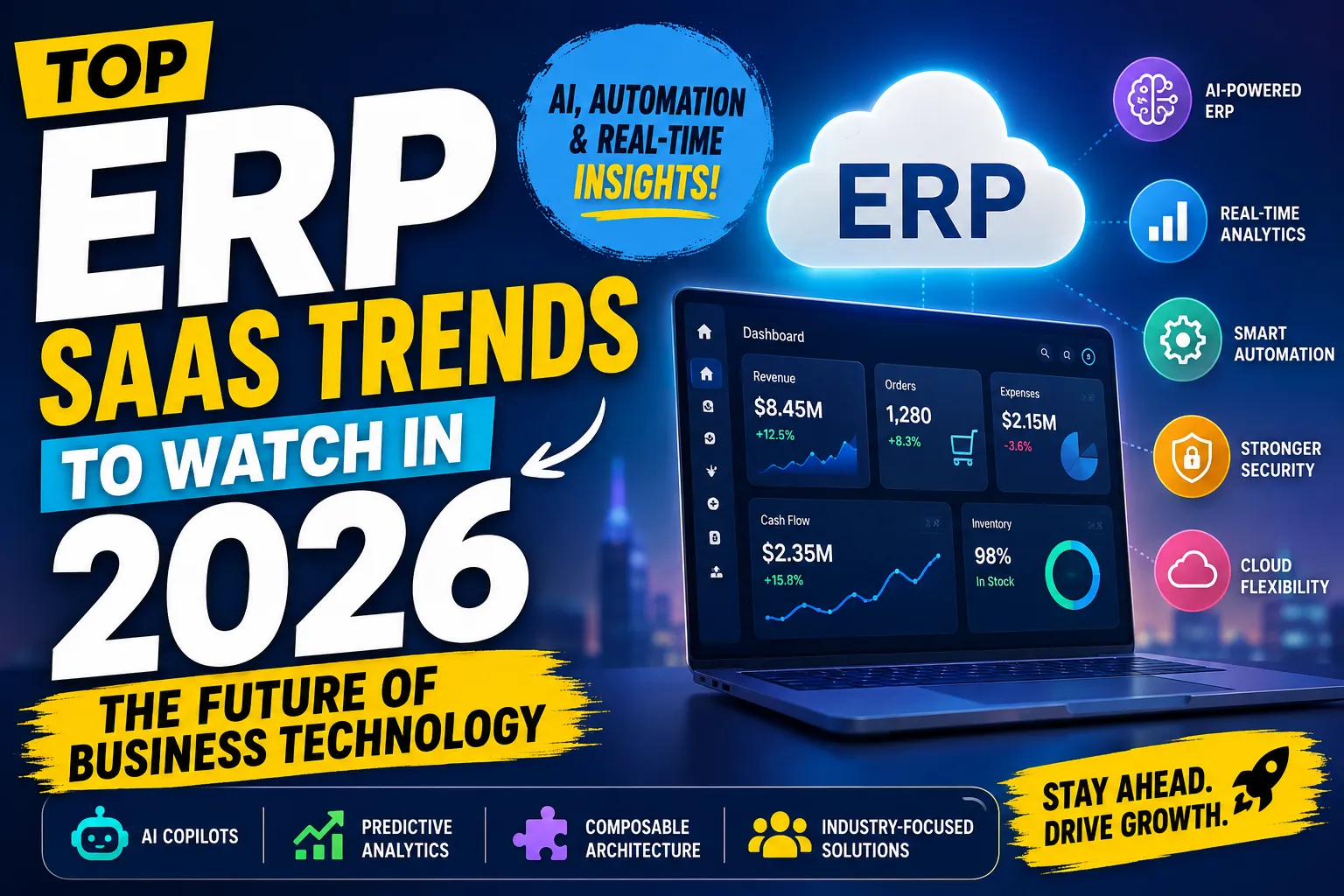
Top ERP SaaS Trends to Watch in 2026: The Future of Business Technology
ERP software used to feel like the giant machine sitting in the corner of the IT department. Companies fed it data, employees complained about it, and executives waited for reports.
That picture has changed fast.
ERP SaaS now sits at the center of business operations, connecting finance, sales, inventory, HR, procurement, customer data, analytics, and automation through cloud-based platforms. In 2026, companies no longer ask whether they need better business software. They ask how quickly they can adopt technology that saves time, reduces errors, and helps people make smarter decisions.
So, what should businesses watch this year?
From AI-powered ERP and real-time analytics to composable architecture, industry-specific platforms, cybersecurity, and intelligent automation, several trends could reshape how companies run their operations.
I have watched ERP technology move from complicated back-office software toward something much more flexible and connected. IMO, that shift matters because businesses now expect software to work with them rather than force them to work around it.
Let’s look at the biggest ERP SaaS trends for 2026 and why they matter for businesses of different sizes.
What Is ERP SaaS?
ERP SaaS combines enterprise resource planning software with the software-as-a-service delivery model.
Instead of installing ERP software on local servers, businesses access the platform through the internet. The provider typically manages infrastructure, updates, security patches, maintenance, and much of the technical administration.
That model gives companies several practical advantages:
- Lower upfront infrastructure costs
- Easier software updates
- Remote accessibility
- Faster deployment
- Scalable subscriptions
- Easier integration with cloud applications
- Centralized business data
- Reduced internal IT maintenance
Imagine running finance, inventory, purchasing, HR, and sales from connected systems instead of juggling several disconnected applications. That connection creates one of the biggest advantages of ERP SaaS.
A good ERP platform gives decision-makers a clearer picture of the business.
And honestly, who wants to spend Friday afternoon combining spreadsheets just to figure out where the money went?
Why ERP SaaS Matters More in 2026
Businesses face tighter budgets, higher customer expectations, faster technology cycles, and increasing pressure to make decisions quickly.
Traditional ERP systems can still deliver tremendous value, but many organizations want more flexibility. They want cloud access, automation, artificial intelligence, integrations, analytics, and faster implementation.
ERP SaaS addresses many of those requirements through a subscription-based cloud model.
The biggest shift involves expectations.
Companies no longer want ERP software that simply records transactions. They want systems that help them understand what happened, identify what might happen next, and recommend what they should do.
That change creates the foundation for the major ERP SaaS trends we see in 2026.
1. AI-Powered ERP Becomes a Core Business Tool
Artificial intelligence has moved beyond the experimental stage.
In 2026, ERP vendors increasingly integrate AI directly into business workflows. Instead of opening a separate AI application, employees can interact with intelligent features inside their ERP environment.
That approach can make AI much more useful because the system already holds relevant business information.
How AI Can Improve ERP
AI-powered ERP systems can help companies with tasks such as:
- Forecasting demand
- Detecting unusual transactions
- Predicting cash-flow changes
- Automating invoice processing
- Summarizing financial information
- Identifying purchasing patterns
- Supporting inventory planning
- Generating business reports
- Answering natural-language questions
- Recommending operational actions
For example, a finance manager could ask, “Which expenses increased the most this quarter?”
Instead of manually building a report, the ERP could analyze the available data and present the relevant information.
That sounds simple, but simple saves time.
AI Agents Could Change ERP Workflows
One of the more interesting developments involves AI agents.
Traditional automation follows predefined rules. An AI agent can potentially interpret information, make decisions within defined boundaries, and complete several connected steps.
For example, an intelligent purchasing workflow could identify low inventory, review approved suppliers, compare available pricing, prepare a purchase request, and send it for human approval.
Businesses still need controls and human oversight, especially for financial decisions. However, AI agents could reduce repetitive administrative work dramatically.
2. ERP Copilots Bring Conversational Interfaces to Business Software
Nobody enjoys clicking through twelve menus to find one number.
ERP vendors increasingly use conversational interfaces to make business systems easier to use. Employees can interact with ERP data through natural-language questions rather than relying entirely on complicated dashboards.
What Could an ERP Copilot Do?
An ERP copilot might help employees:
- Explain financial reports
- Summarize sales performance
- Find overdue invoices
- Identify inventory shortages
- Draft purchase requests
- Create basic reports
- Explain unusual transactions
- Compare business performance
- Find specific records
This trend could reduce the learning curve for new employees.
It could also help smaller companies access advanced ERP capabilities without hiring specialists for every task.
FYI, conversational ERP does not mean businesses should hand every decision to an AI chatbot. Smart companies will combine AI assistance with permissions, approval workflows, auditing, and human judgment.
3. Real-Time Analytics Will Replace Slow Reporting Cycles
Businesses move quickly, but traditional reporting often moves slowly.
A company might wait for employees to collect data, clean spreadsheets, reconcile records, create reports, and distribute them. By the time executives review everything, the situation may have changed.
Real-time ERP analytics can shorten that gap.
Modern ERP platforms can connect operational data with dashboards and analytical tools. Managers can monitor sales, expenses, inventory, purchasing, cash flow, and other metrics closer to the moment they happen.
Why Real-Time Data Matters
Consider inventory.
A retailer that discovers a popular product shortage three weeks later has already lost opportunities. A business that identifies the problem quickly can reorder stock, adjust purchasing, or change promotions.
The same principle applies to finance.
Real-time visibility can help companies identify:
- Rising expenses
- Falling margins
- Delayed payments
- Inventory problems
- Sales changes
- Supplier issues
- Cash-flow pressure
The goal does not involve collecting more dashboards. The goal involves making better decisions sooner.
4. Predictive Analytics Will Help Businesses Look Ahead
Traditional ERP reporting answers questions about the past.
Predictive analytics tries to answer questions about the future.
That difference could become increasingly important in 2026.
Businesses can use predictive models to estimate demand, revenue, inventory requirements, cash-flow conditions, and potential operational problems.
Predictive ERP Examples
A predictive ERP system might identify that:
- A product could experience higher demand next month.
- A customer could pay later than usual.
- Inventory levels could fall below a target.
- A supplier could create a delivery risk.
- Certain expenses could exceed the budget.
- A sales pipeline could miss its target.
Of course, predictions do not guarantee outcomes.
Businesses still need judgment.
But a useful prediction can give managers more time to respond. And in business, extra time often matters more than perfect information.
5. Composable ERP Architecture Will Gain Momentum
Here comes one of the more technical trends.
Composable ERP allows businesses to build technology environments from modular applications and services rather than relying on one massive system for everything.
Instead of replacing an entire ERP platform whenever the company needs a new capability, businesses can connect specialized applications through APIs and integration tools.
Why Companies Like Composable ERP
A modular approach can provide:
- Greater flexibility
- Faster technology changes
- Easier integrations
- More specialized applications
- Reduced dependence on one system
- Easier experimentation
Imagine a business using one core ERP for finance and operations while connecting specialized applications for ecommerce, analytics, customer experience, payroll, or logistics.
That approach can work well for growing companies with changing requirements.
However, composable architecture also creates complexity. More applications mean more integrations, vendors, permissions, and security considerations.
Flexibility sounds wonderful until someone has to maintain thirty integrations. 🙂
6. Industry-Specific ERP SaaS Will Become More Popular
Generic ERP platforms offer broad capabilities.
However, different industries operate very differently.
A manufacturer needs production planning and supply-chain management. A healthcare organization needs specialized workflows and compliance controls. A construction company needs project management, job costing, procurement, and workforce coordination.
That difference creates demand for industry-specific ERP SaaS solutions.
Examples of Industry-Focused ERP
ERP SaaS providers can target industries such as:
- Manufacturing
- Construction
- Healthcare
- Retail
- Professional services
- Logistics
- Distribution
- Hospitality
- Agriculture
- Financial services
Industry-specific ERP can reduce customization because vendors already understand common workflows.
For businesses with specialized requirements, that advantage can make implementation easier.
7. ERP Integration Will Become More Important Than Ever
No ERP system operates completely alone anymore.
Businesses use payment platforms, ecommerce applications, CRM systems, payroll tools, marketing platforms, logistics software, collaboration tools, and analytics applications.
That makes ERP integration one of the biggest technology priorities for 2026.
APIs Will Drive Connected Business Systems
Application programming interfaces allow different systems to communicate.
For example, an ecommerce platform can send order information to an ERP. The ERP can update inventory and financial records. A shipping platform can then receive fulfillment information.
That connection can eliminate duplicate data entry.
Businesses should evaluate ERP platforms based on integration capabilities rather than simply counting built-in features.
A platform with fewer features but excellent integrations can sometimes outperform a giant platform that struggles to communicate with everything else.
8. Automation Will Move Beyond Simple Tasks
ERP automation has existed for years.
Businesses already automate invoice processing, payment reminders, approvals, payroll calculations, and recurring reports.
In 2026, automation will increasingly connect multiple steps into complete workflows.
Intelligent Automation in ERP
A modern automated workflow might:
- Receive an invoice.
- Extract relevant information.
- Match the invoice with a purchase order.
- Check approval rules.
- Identify discrepancies.
- Route the invoice to the correct employee.
- Record the transaction.
- Prepare it for payment.
That workflow removes many manual steps.
Employees can then focus on exceptions rather than routine transactions.
The best automation does not simply make software faster. It gives people more time to perform higher-value work.
9. Embedded Finance Will Strengthen ERP Platforms
ERP systems already manage financial information.
Now vendors increasingly want to connect financial services directly to business workflows.
This trend, often called embedded finance, can connect ERP environments with payments, lending, banking, expense management, invoicing, and other financial services.
For example, a company could manage invoices and payment activities from the same environment where it manages accounting.
That integration could reduce friction.
It may also give businesses better visibility into cash flow because financial activities connect more closely with operational data.
10. Cybersecurity Will Become a Major ERP Buying Factor
More cloud software creates more opportunities for efficiency.
It also creates more security responsibilities.
ERP systems contain extremely valuable information, including financial records, employee data, supplier information, customer records, and operational details.
A security incident can create serious financial and reputational damage.
What Should Businesses Look For?
Companies should evaluate:
- Multi-factor authentication
- Role-based access controls
- Encryption
- Audit logs
- Security monitoring
- Backup and recovery
- Data privacy controls
- Vendor security practices
- Compliance capabilities
- Identity management
Businesses should also follow the principle of least privilege.
Employees should receive the access they actually need rather than unrestricted access to everything.
That sounds obvious, yet companies still manage permissions poorly. Technology cannot fix careless access policies by itself.
11. ERP Vendors Will Focus More on Data Governance
AI needs data.
Analytics needs data.
Automation needs data.
ERP needs data.
So, what happens when the data contains duplicates, errors, missing information, or inconsistent formats?
Everything downstream suffers.
Data quality and governance will become increasingly important in 2026.
Companies should establish clear rules for:
- Data ownership
- Data accuracy
- Data access
- Data retention
- Data classification
- Duplicate records
- Data security
- Integration standards
A fancy AI system cannot magically transform messy data into perfect business intelligence.
Garbage data still creates garbage results.
12. Low-Code and No-Code ERP Customization Will Expand
Businesses often need customization.
However, traditional customization can require developers, long development cycles, and expensive consulting projects.
Low-code and no-code tools offer another approach.
Business users can create workflows, forms, dashboards, approval processes, and simple applications through visual interfaces.
Why This Trend Matters
Low-code ERP customization can help businesses:
- Build workflows faster
- Reduce development costs
- Adapt processes internally
- Create custom dashboards
- Automate approvals
- Connect business applications
This trend could give departments more control over their technology.
However, companies still need governance.
Without proper controls, every department could build its own mini-system. That creates the exact technology mess ERP tries to eliminate.
13. Mobile ERP Will Keep Growing
Employees no longer work exclusively from office desktops.
Sales teams travel. Managers work remotely. Warehouse workers use mobile devices. Executives check business performance from anywhere.
That makes mobile ERP access increasingly important.
A strong mobile ERP experience should allow authorized users to:
- Approve expenses
- Review dashboards
- Check inventory
- Approve purchase orders
- Monitor sales
- View financial information
- Receive alerts
- Complete workflow tasks
The mobile experience should not feel like a tiny version of an old desktop application.
Users expect fast, simple interfaces.
14. Sustainability Data Will Enter ERP Workflows
Sustainability has become a business issue rather than a marketing-only topic.
Companies increasingly track energy use, supply-chain information, waste, transportation, and other environmental metrics.
ERP platforms can provide valuable data for those calculations.
ERP and Sustainability
Companies can use ERP data to monitor:
- Energy consumption
- Supply-chain activity
- Material usage
- Transportation
- Waste
- Procurement patterns
- Operational efficiency
Better visibility can also produce financial benefits.
For example, reducing waste can lower costs. Improving transportation efficiency can reduce fuel expenses. Better inventory planning can reduce excess stock.
That makes sustainability another area where operational data can support smarter decisions.
15. Digital Supply Chain Management Will Become Smarter
Supply chains have faced plenty of disruption in recent years.
Businesses now want more visibility and flexibility.
ERP SaaS platforms can connect purchasing, inventory, suppliers, logistics, production, and financial data.
AI and predictive analytics can then help companies identify potential problems earlier.
Smarter Supply Chain Capabilities
Businesses can use ERP technology to improve:
- Demand forecasting
- Inventory optimization
- Supplier management
- Purchase planning
- Logistics coordination
- Production scheduling
- Order tracking
The goal involves moving from reactive management to proactive planning.
Instead of asking, “Why did we run out of stock?”
A better ERP environment helps ask, “What could cause a shortage next month, and what should we do now?”
That represents a major shift.
16. ERP Implementation Will Focus More on Speed and Usability
ERP implementation has earned a reputation for being complicated.
Companies often spend months or years configuring systems, migrating data, training employees, and changing workflows.
SaaS platforms can shorten implementation timelines, especially when businesses choose standardized processes instead of excessive customization.
What Makes an ERP Implementation Successful?
Businesses should:
- Define clear objectives.
- Identify essential workflows.
- Clean existing data.
- Select the right implementation team.
- Train employees early.
- Test integrations.
- Establish security policies.
- Measure adoption.
- Launch in manageable stages.
- Continue improving after launch.
Technology alone cannot rescue a badly planned implementation.
People need to understand why the company changed the system and how the new workflow helps them.
17. User Experience Will Influence ERP Buying Decisions
ERP software once prioritized functionality over simplicity.
That mindset no longer works as well.
Employees expect business software to feel intuitive.
User experience will become a major differentiator among ERP SaaS platforms.
A system can offer hundreds of features, but employees will avoid those features if the interface frustrates them.
Companies should evaluate:
- Navigation
- Search
- Mobile usability
- Dashboard design
- Workflow simplicity
- Accessibility
- Personalization
- Training requirements
A beautiful interface cannot replace powerful functionality, but confusing software can undermine powerful functionality.
18. ERP Personalization Will Become More Intelligent
Different employees need different information.
A CFO may care about cash flow and profitability. A warehouse manager may care about inventory levels. A sales manager may care about pipeline performance.
ERP systems increasingly support personalized dashboards and workflows.
AI could push this further by adapting information based on roles, behavior, priorities, and business conditions.
Instead of showing everyone the same dashboard, the ERP could highlight information that matters most to each user.
That approach can reduce information overload.
19. ERP SaaS Pricing Models Will Evolve
ERP pricing has traditionally relied heavily on users, modules, features, or transaction volumes.
As AI and automation grow, vendors may experiment with new pricing models.
Businesses could encounter combinations of:
- Per-user pricing
- Per-module pricing
- Usage-based pricing
- Transaction-based pricing
- AI feature pricing
- Enterprise subscriptions
Companies should look beyond the advertised monthly price.
Calculate the Real ERP Cost
Consider:
- Subscription fees
- Implementation
- Data migration
- Integration
- Training
- Customization
- Support
- Additional modules
- AI usage
- Third-party applications
A cheap ERP can become expensive when every useful feature requires another add-on.
20. ERP Will Become a Strategic Decision-Making Platform
This trend might matter most.
ERP systems increasingly connect operational data with analytics, AI, automation, and planning.
That means ERP can move beyond record keeping.
The future ERP acts more like a business intelligence and decision-support platform.
Executives can use ERP data to understand performance. Managers can use it to identify problems. Employees can use automation to complete routine work.
The ERP becomes part of the company’s operating system for decision-making.
And that changes how companies should evaluate ERP software.
Instead of asking, “How many features does this platform have?”
Ask:
“Can this system help us run the business better?”
That question cuts through a lot of marketing noise.
How Businesses Should Prepare for ERP SaaS Trends in 2026
You do not need to adopt every new technology immediately.
In fact, trying to implement everything at once can create more problems than it solves.
Start with the business problems that matter most.
Step 1: Identify Operational Bottlenecks
Find the processes that consume too much time.
Look at:
- Manual data entry
- Repetitive reporting
- Slow approvals
- Inventory problems
- Payment delays
- Poor visibility
- Duplicate data
- Disconnected applications
These problems can help you identify where ERP technology can deliver measurable value.
Step 2: Evaluate Your Data
Before implementing AI or advanced analytics, examine your data quality.
Ask:
- Do systems share consistent information?
- Do duplicate records exist?
- Can employees access the right data?
- Do departments use different definitions?
- Can you trust your reports?
Fixing data problems can produce more value than buying another shiny software feature.
Step 3: Prioritize Integration
Make a list of your essential business applications.
Then determine how your future ERP will connect with them.
Integration should become part of the ERP selection process, not an afterthought.
Step 4: Start With High-Value Automation
Do not automate everything simply because you can.
Choose workflows that create measurable savings.
Invoice processing, approvals, reporting, customer updates, and inventory alerts often provide practical starting points.
Step 5: Prepare Employees for AI
Employees need to understand how AI will affect their work.
Explain:
- Which tasks AI will support
- Which decisions require human approval
- How employees should verify AI outputs
- How the company will protect data
- How performance expectations may change
Technology adoption works better when employees understand the purpose behind the change.
What Should Companies Look for in an ERP SaaS Platform?
Choosing an ERP platform requires more than comparing feature lists.
Look for a system that matches your company’s current needs while leaving room for growth.
Here are some important evaluation criteria:
- AI and automation capabilities
- Integration and API support
- Security controls
- Scalability
- Mobile access
- Analytics and reporting
- Industry-specific functionality
- Customization options
- Data migration tools
- Implementation support
- Transparent pricing
- User experience
- Vendor reliability
Also consider your employees.
A technically impressive ERP that nobody wants to use will not deliver the expected return.
The Biggest ERP SaaS Mistakes to Avoid in 2026
Companies can make expensive mistakes even when they choose good software.
Watch out for these common problems:
Choosing Features Instead of Outcomes
More features do not automatically create more value.
Focus on business outcomes.
Over-Customizing the Platform
Customization can make ERP fit your current process perfectly.
It can also make future upgrades painful.
Use standard workflows where they make sense.
Ignoring Data Quality
Bad data can damage analytics, automation, and AI.
Clean your information before relying heavily on intelligent features.
Treating Security as an IT-Only Issue
Security affects every employee.
Build access controls and security awareness into the implementation process.
Forgetting Change Management
Employees need training and communication.
Otherwise, they may return to spreadsheets and disconnected tools.
And once spreadsheets sneak back into the workflow, they tend to multiply like rabbits.
The Future of ERP SaaS: What Comes Next?
The ERP market will continue moving toward intelligent, connected, automated, and flexible business platforms.
AI will help employees analyze information and automate tasks. Real-time analytics will shorten decision cycles. Composable architecture will give businesses more flexibility. Industry-specific platforms will provide more targeted functionality.
At the same time, security, data governance, integration, and user experience will become even more important.
The winning ERP platforms will not necessarily offer the longest feature list.
They will help businesses accomplish more with less friction.
Final Thoughts on ERP SaaS Trends in 2026
ERP SaaS has moved far beyond cloud-hosted accounting and basic business administration.
AI-powered automation, real-time analytics, predictive intelligence, composable architecture, stronger integrations, industry-specific software, cybersecurity, mobile access, and better user experiences will shape the next phase of ERP technology.
But businesses should avoid chasing trends simply because vendors put them on a glossy presentation.
The smartest approach starts with a simple question:
What problem are we trying to solve?
If AI can reduce repetitive work, use it. If real-time analytics can improve decisions, invest in it. If integration can eliminate duplicate data entry, prioritize it. If a simpler workflow can improve employee adoption, choose simplicity.
Technology should support the business, not become another business problem.
Personally, I think that idea captures the real future of ERP SaaS. The best systems will quietly handle repetitive work, surface useful information, connect teams, and help people make better decisions.
And if your ERP can save your team from another spreadsheet marathon, that alone feels like progress.
Read More: ERP SaaS Implementation Steps Every Company Should Know
Tools: fybos.com